Enterprise AI Technology Explainer

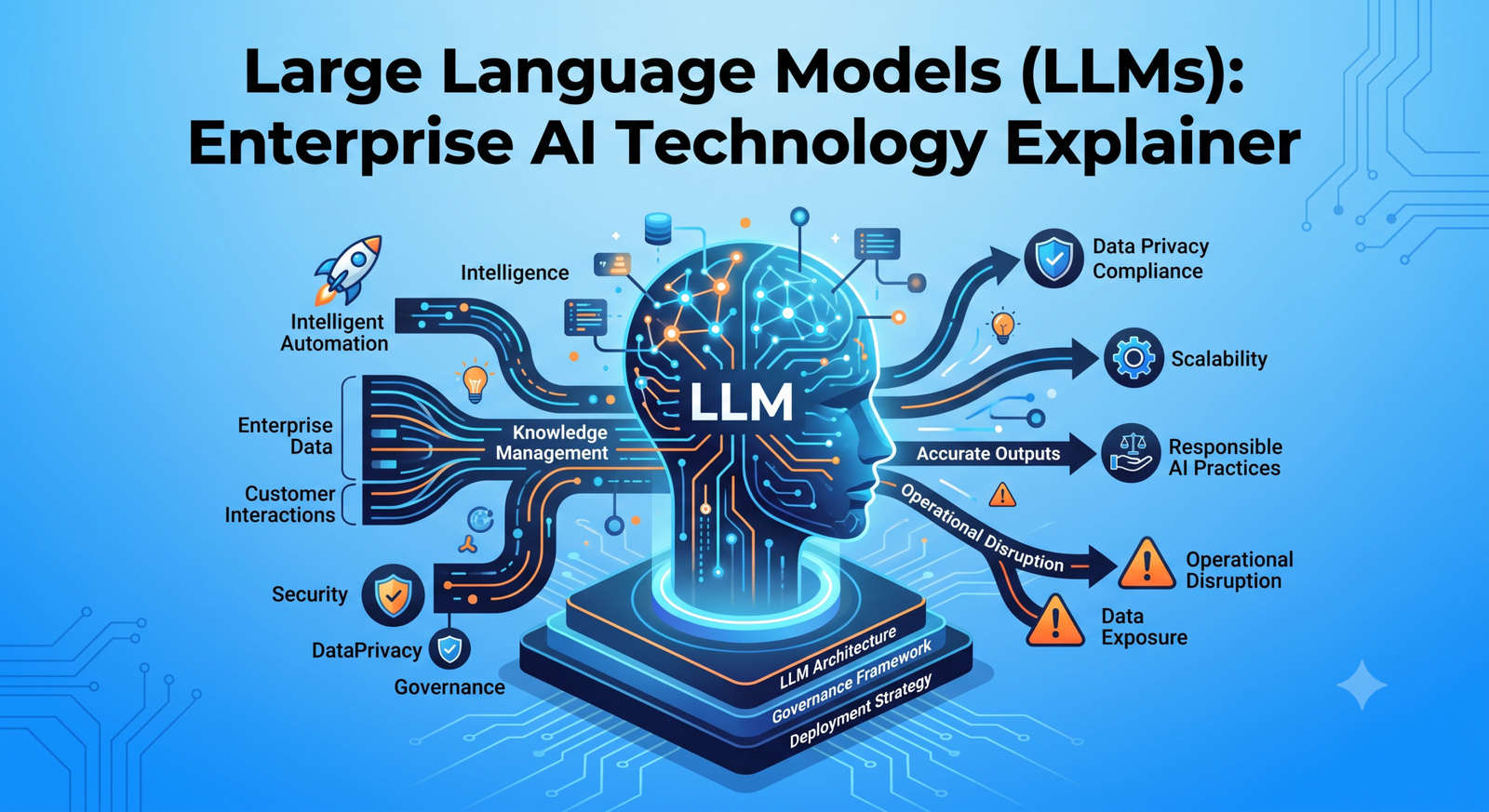
Large Language Models are transforming enterprise operations by enabling intelligent automation, faster decision-making, and natural language interactions at scale.
Large Language Models (LLMs) are the foundation of modern generative AI, powering applications that understand, generate, and analyze human language.
Enterprises are integrating LLMs into customer service, software development, knowledge management, and business operations to improve efficiency and innovation.
LLMs unlock enterprise value when combined with trusted data, governance, and security rather than used as standalone AI tools.
Successful enterprise adoption requires balancing model performance with data privacy, compliance, scalability, and responsible AI practices.
⚠ Within the next 2–4 years, organizations deploying LLMs without governance frameworks risk inaccurate outputs, data exposure, compliance failures, and operational disruption.
For CIOs, AI leaders, and technology teams, understanding LLM capabilities and limitations is critical for building secure, enterprise-ready AI solutions.
- How Large Language Models work
- Enterprise AI use cases
- LLM security and governance
- Model selection and deployment
- Responsible AI best practices
A clear understanding of LLMs enables organizations to accelerate AI adoption while reducing implementation risk and maximizing business value.
Enterprise LLM Adoption Guide
Explore how Large Language Models can transform enterprise operations with practical implementation strategies and governance recommendations.
✔ LLM architecture overview
✔ Enterprise use cases
✔ AI governance framework
✔ Deployment best practices
Download Full Content✔ LLM architecture overview
✔ Enterprise use cases
✔ AI governance framework
✔ Deployment best practices