
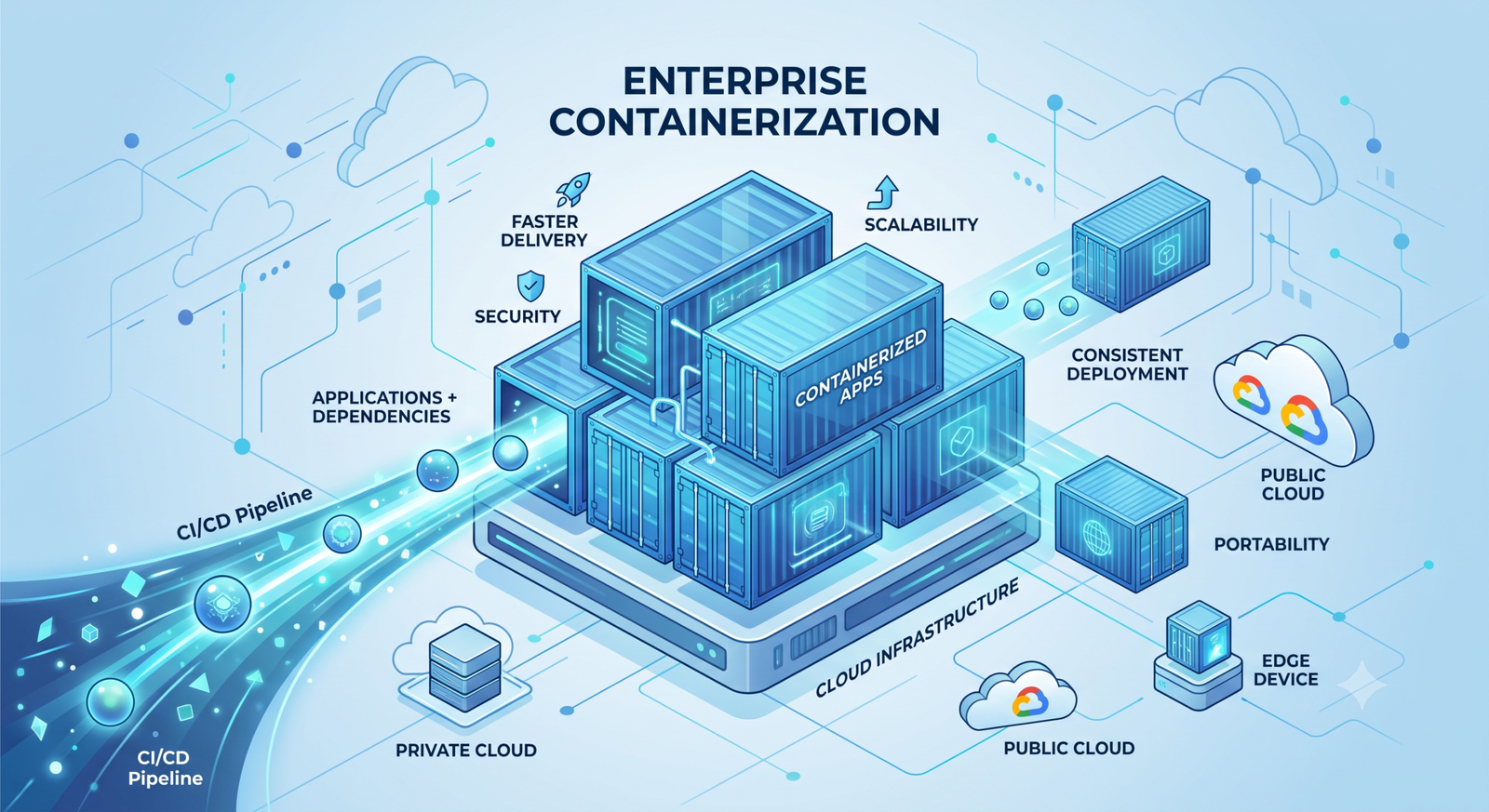
Modern enterprises are adopting containerization to simplify application deployment across on-premises infrastructure, hybrid cloud, and multi-cloud environments.
Containers provide lightweight, portable environments that improve development speed, resource efficiency, and consistency throughout the software lifecycle.
When combined with DevOps, Kubernetes, and CI/CD pipelines, containerization accelerates software delivery without compromising reliability or performance.
For CIOs, DevOps leaders, and platform engineering teams, containerization is a critical building block for cloud-native transformation.
- Container architecture fundamentals
- Application portability and scalability
- DevOps and CI/CD integration
- Cloud-native deployment strategies
- Container security best practices
Understanding containerization helps enterprises modernize application delivery while improving efficiency, resilience, and business scalability.
✔ Container technology overview
✔ Deployment best practices
✔ Security implementation guidance
✔ Modernization roadmap