
Cloud Resilience Architecture Report

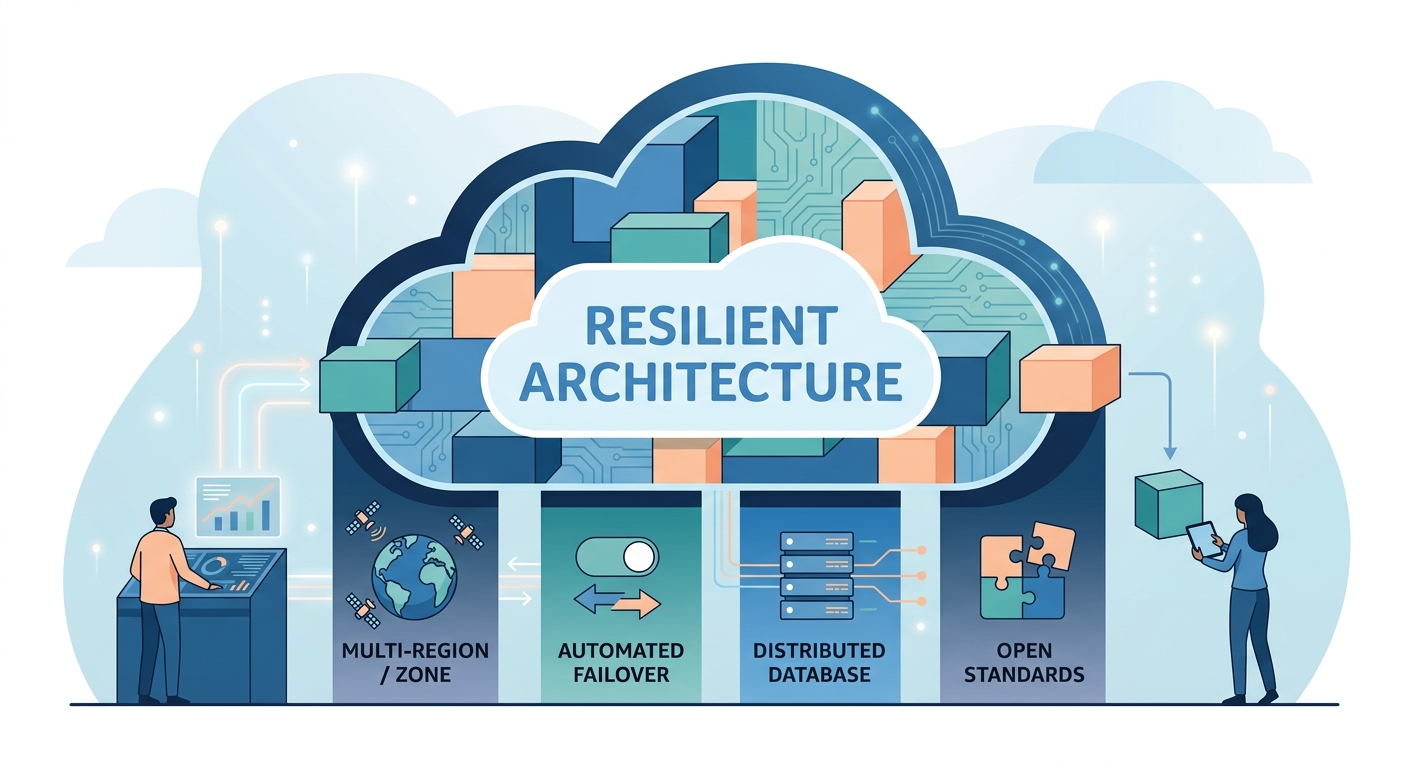
Single-zone dependencies and weak failover design can disrupt revenue systems, customer access, and enterprise operations during the next major outage event.
Cloud adoption simplified deployment, but it also introduced new architectural trade-offs across performance, complexity, and operational control.
Enterprise teams now need multi-layer resilience, scalable data platforms, and maintainable systems that withstand demand spikes and provider failures.
High-growth businesses do not fail from one outage alone—they fail when architecture cannot recover fast enough across applications, networks, and data layers.
Leaders are shifting from basic uptime planning to fault-aware design spanning regions, services, DNS, databases, and automated recovery workflows.
⚠ Within the next 3–5 years, organizations relying on single-region or tightly coupled cloud services face higher risk of downtime, transaction loss, and customer churn during cascading failures.
Modern architecture strategy now impacts competitiveness, cost efficiency, and business continuity across digital platforms.
- Deploy workloads across multiple zones and regions
- Use open APIs to reduce provider lock-in risk
- Build automated failover for network and DNS layers
- Adopt distributed databases with replication
This approach strengthens resilience, accelerates recovery, and improves confidence for CIOs, CTOs, and infrastructure leaders.
Enterprise Cloud Resilience Assessment Report
Identify hidden architecture gaps before they impact revenue, security, or service availability.
✔ Outage exposure analysis
✔ Multi-region readiness review
✔ Data resilience roadmap
✔ Executive action priorities
Download Full Report✔ Outage exposure analysis
✔ Multi-region readiness review
✔ Data resilience roadmap
✔ Executive action priorities