AI-Native Software Delivery Intelligence Report

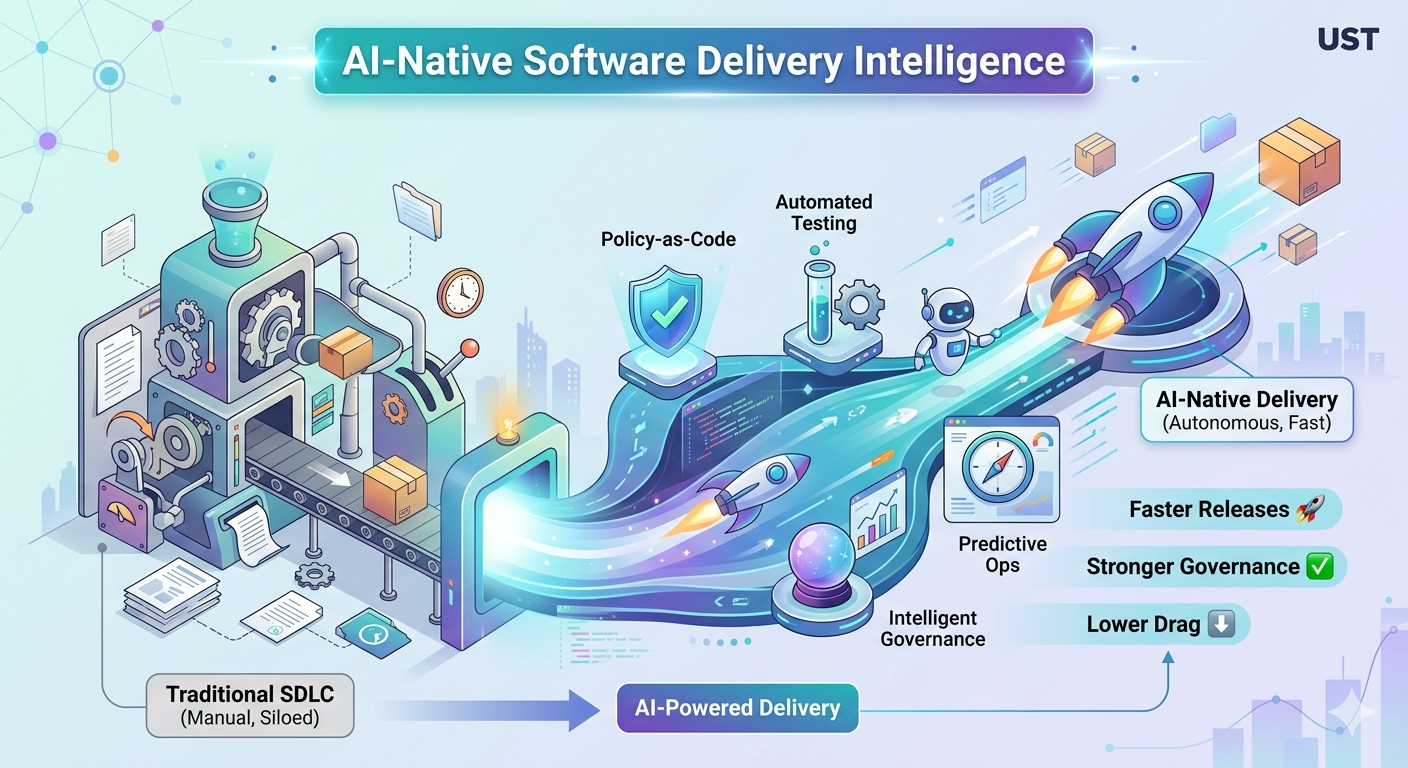
Legacy SDLC models cannot support AI-speed delivery. Enterprises that modernize now gain faster releases, stronger governance, and lower operational drag.
Traditional pipelines were built for manual approvals, siloed tooling, and human-paced development cycles.
As AI-generated code scales over the next 3–5 years, enterprise teams need autonomous workflows with continuous control.
The competitive gap will widen between organizations using AI-native delivery models and those constrained by legacy release systems.
AI-native SDLC embeds policy-as-code, automated testing, predictive operations, and intelligent agents across engineering workflows.
⚠ Delayed modernization can increase release bottlenecks, compliance gaps, service outages, and rising cloud costs across critical business platforms.
For CIOs, CTOs, and platform leaders, this shift impacts speed, resilience, and technology investment returns.
- Up to 70% faster test creation
- Up to 56% less manual deployment effort
- Up to 70% faster incident resolution
- 40–50% better cloud efficiency
Early pilots in CI/CD, testing, or SRE can deliver measurable ROI before enterprise-wide rollout.
Enterprise AI Delivery Readiness Blueprint
Assess how prepared your software delivery model is for AI-scale execution and governance.
✔ Maturity gap analysis
✔ Automation roadmap
✔ Cost reduction opportunities
✔ Executive transformation priorities
Download the Report✔ Maturity gap analysis
✔ Automation roadmap
✔ Cost reduction opportunities
✔ Executive transformation priorities