
AI Data Center Cooling Strategy Report
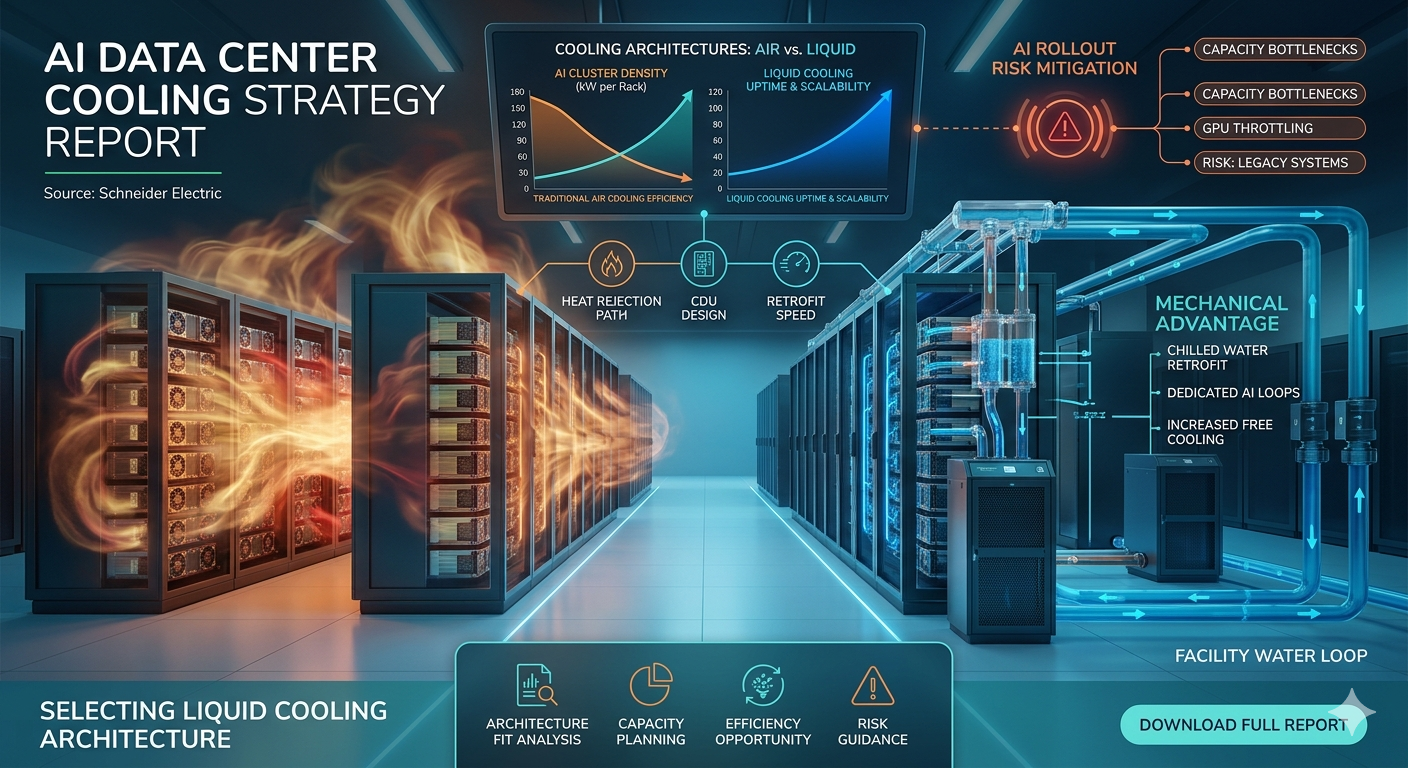
AI clusters now outpace legacy cooling capacity, making liquid cooling architecture a board-level infrastructure decision for uptime, cost, and scalability.
High-density GPU servers for training and inference generate thermal loads traditional air systems struggle to manage efficiently.
Enterprise operators must now align cooling design with deployment speed, expansion plans, and long-term energy strategy.
The wrong liquid cooling architecture can delay AI rollout, cap compute density, and increase operating cost for years.
Selection depends on three factors: heat rejection path, CDU design, and how existing facility infrastructure can be leveraged or upgraded.
⚠ Within the next 12–24 months, enterprises scaling AI on legacy cooling systems risk capacity bottlenecks, GPU throttling, downtime events, and rising power costs across critical data center operations.
Organizations adopting AI at scale are redesigning mechanical infrastructure as a competitive advantage, not a facilities afterthought.
- Use existing chilled water for faster retrofits
- Deploy dedicated loops for large AI clusters
- Match rack vs floor CDU to density targets
- Increase free cooling hours and efficiency
For CTOs and infrastructure leaders, cooling readiness now directly influences AI deployment speed, resilience, and total cost of ownership.
Enterprise AI Cooling Readiness Assessment
Identify the best-fit liquid cooling model for your AI environment and reduce infrastructure risk before expansion.
✔ Architecture fit analysis
✔ Capacity planning roadmap
✔ Efficiency opportunity review
✔ Deployment risk guidance
Download Full Report✔ Architecture fit analysis
✔ Capacity planning roadmap
✔ Efficiency opportunity review
✔ Deployment risk guidance