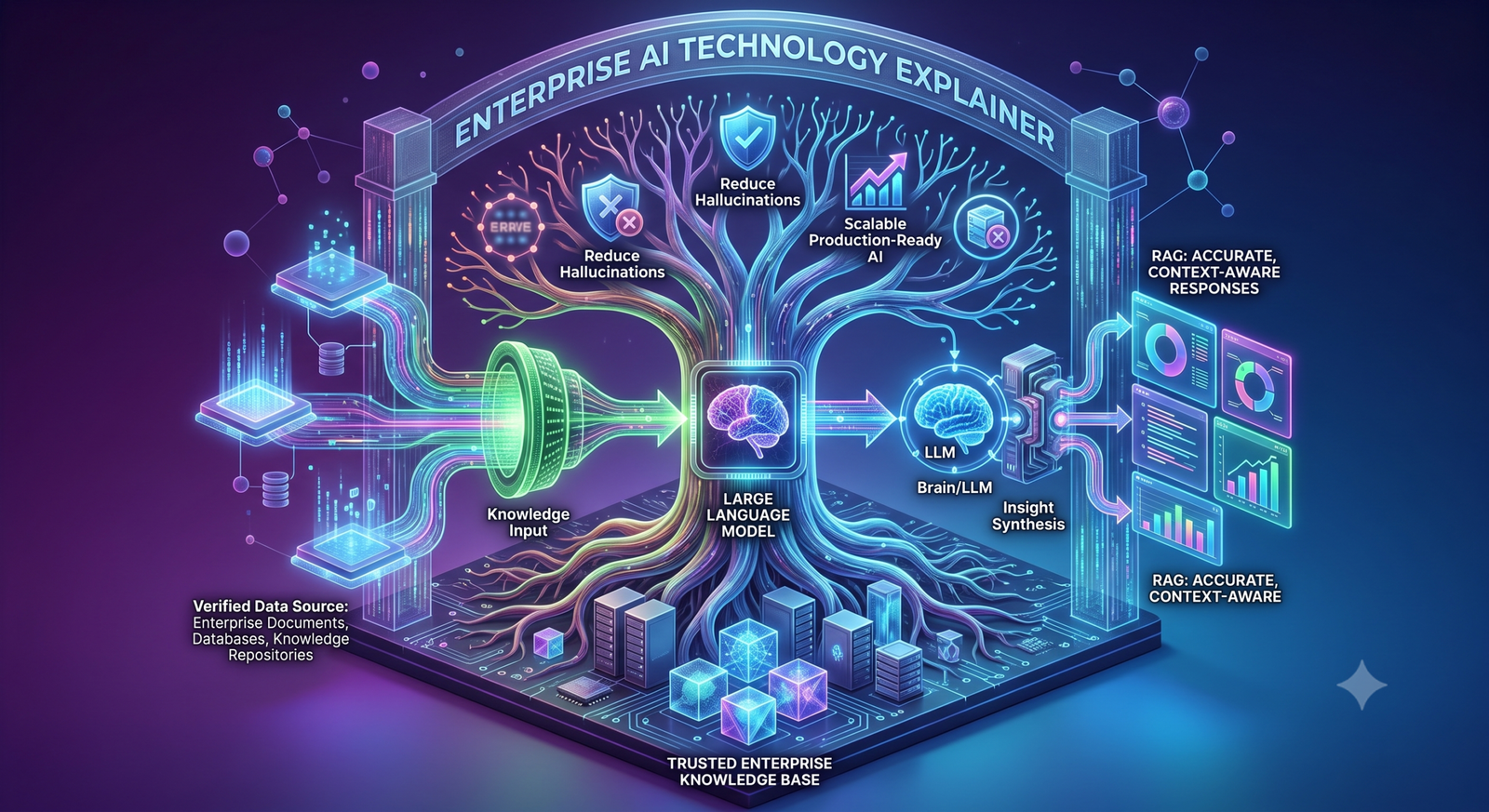
As enterprises adopt generative AI, improving response accuracy and reducing AI hallucinations have become critical business priorities.
RAG enhances AI systems by retrieving verified information from enterprise data before generating responses, improving reliability and governance.
By connecting AI to internal documents, databases, and knowledge repositories, organizations gain more accurate, secure, and explainable AI outcomes.
For CIOs, AI leaders, and enterprise architects, RAG is becoming the preferred approach for scalable, secure, and production-ready AI applications.
- Ground AI with enterprise knowledge
- Reduce hallucinations and misinformation
- Improve compliance and data governance
- Enable secure enterprise AI deployment
- Increase response accuracy and trust
Understanding RAG helps organizations build AI solutions that deliver measurable business value while maintaining accuracy and governance.
Learn how Retrieval-Augmented Generation can improve AI accuracy, strengthen governance, and accelerate enterprise AI adoption.
- ✔ RAG architecture overview
- ✔ AI implementation roadmap
- ✔ Governance best practices
- ✔ Enterprise deployment insights