Financial AI Consolidation Intelligence Report

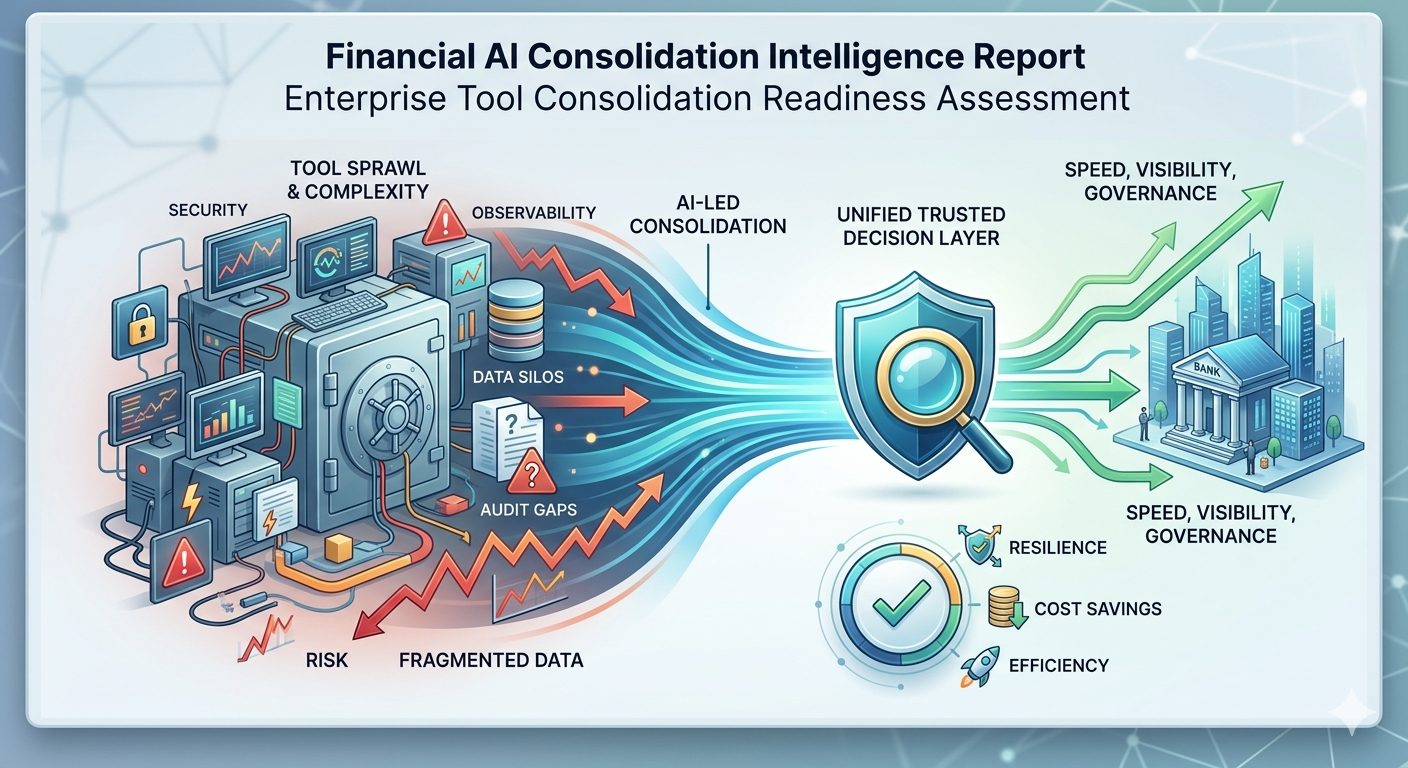
Financial institutions are losing speed and visibility to tool sprawl. AI-led consolidation is becoming a board-level efficiency and risk priority.
Banks and financial firms built large stacks of monitoring, analytics, and security tools over time, creating fragmented operations.
Enterprise leaders are now shifting toward unified platforms that reduce complexity, improve governance, and accelerate response.
The competitive edge is no longer owning more tools—it is turning fragmented enterprise data into one trusted decision layer.
AI observability can normalize signals, correlate incidents, and remove manual handoffs between IT, security, and operations teams.
⚠ Within the next 12–24 months, firms that keep siloed tools may face slower incident response, rising outages, audit gaps, and higher operational costs across critical financial systems.
For CIOs and security leaders, consolidation improves resilience, release velocity, and confidence to retire underused platforms that add little value.
- Unified security and observability platforms
- Federated search across remote datasets
- Standardized cloud data onboarding
- Risk-based alert prioritization
- Automated response workflows
This approach strengthens governance while freeing budgets for higher-value transformation initiatives.
Enterprise Tool Consolidation Readiness Assessment
Identify where tool sprawl is increasing risk and slowing operations for your enterprise teams.
✔ Redundant tool exposure analysis
✔ Incident response maturity review
✔ Cost reduction opportunities
✔ Strategic modernization roadmap
Download the Report✔ Redundant tool exposure analysis
✔ Incident response maturity review
✔ Cost reduction opportunities
✔ Strategic modernization roadmap