
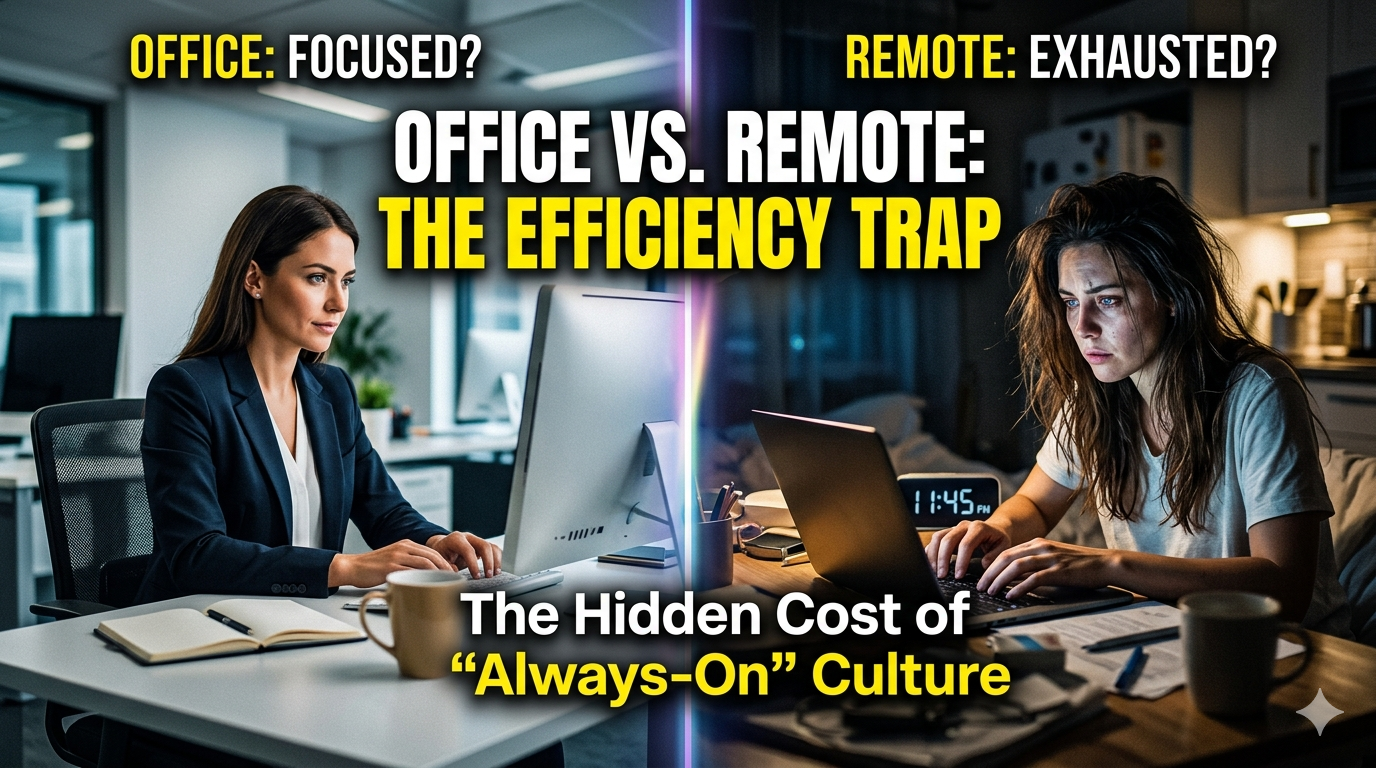
The global shift to remote work accelerated rapidly in 2020, forcing companies to rethink how productivity is measured.
While early reports suggested increased output, deeper analysis reveals a more complex reality—one where longer working hours often replace true efficiency gains.
A 2020 study by Stanford University found that remote workers showed a 13% performance increase. However, much of this gain came from extended working hours and fewer breaks.
Similarly, Microsoft’s Work Trend Index highlighted that employees were working more frequently outside standard hours, indicating a shift toward “always-on” work culture.
The World Health Organization has classified burnout as an occupational phenomenon, linking it to chronic workplace stress that is not successfully managed.
From a business perspective, companies benefit significantly:
- Reduced office infrastructure and operational costs
- Access to global talent pools
- Higher output per employee (on paper)
- Lower absenteeism rates
However, employees often experience the opposite side of the equation:
- Extended working hours beyond official schedules
- Lack of clear work-life separation
- Increased digital fatigue from constant meetings
- Isolation and reduced team engagement
This creates a critical question for modern organizations: are productivity gains sustainable, or are they driven by unsustainable employee effort?
Hybrid models are emerging as a potential solution, combining flexibility with structured collaboration. However, without proper boundaries and policies, even hybrid setups can replicate the same issues.
Ultimately, organizations must shift from measuring productivity by output alone to evaluating employee well-being, engagement, and long-term performance.
✔ Are you more productive or just working longer hours?
✔ Has flexibility improved your work-life balance?
✔ Or has it increased stress and burnout?
Your insights matter in shaping the future workplace.