
Clinical AI Trust & Operational Risk Report

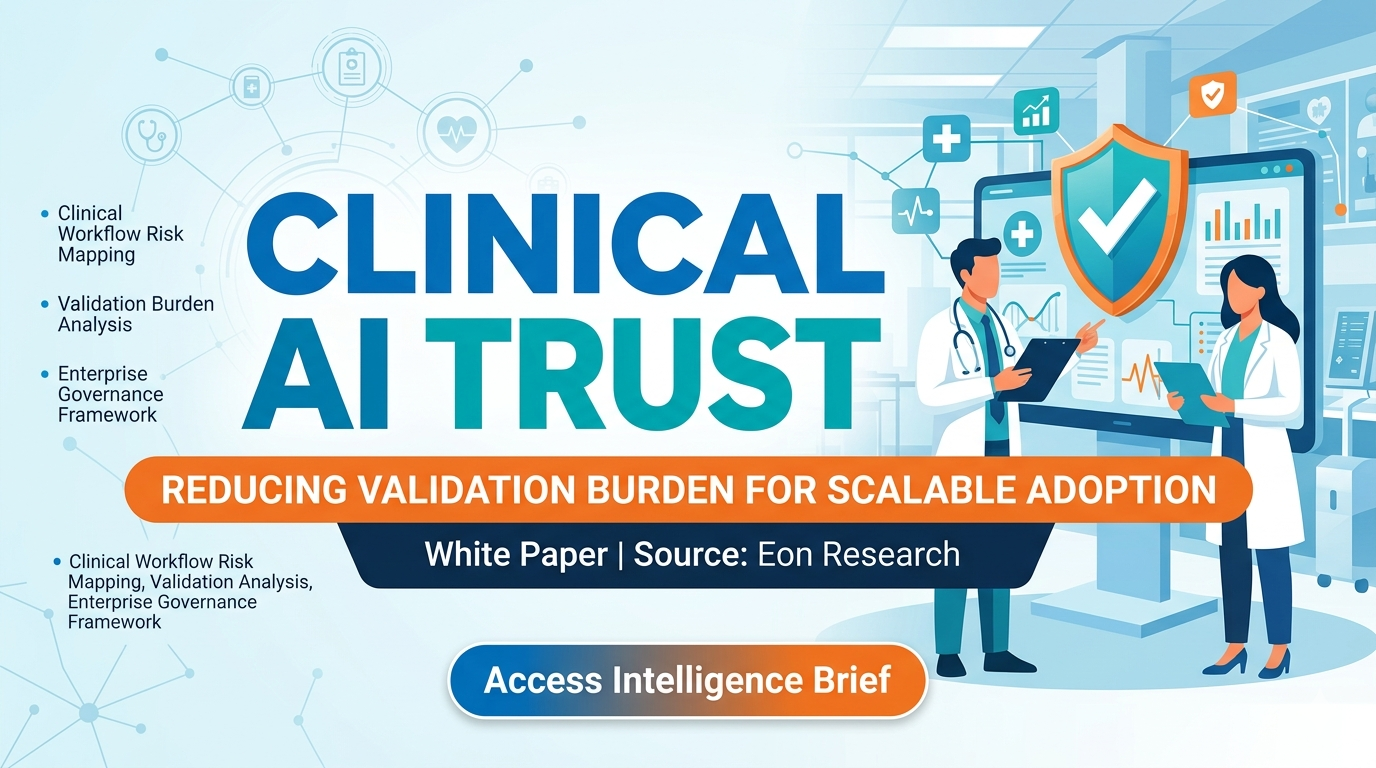
Clinical AI is shifting from experimental capability to operational dependency, where sustained trust becomes the primary constraint to scale in health systems.
As artificial intelligence becomes embedded in clinical workflows, healthcare systems are transitioning from experimentation to accountability-driven deployment.
Enterprise care teams are no longer asking whether AI can be applied, but whether it can be reliably trusted in high-risk clinical environments.
Trust in clinical AI is determined by validation burden and system behavior consistency, not standalone model accuracy.
Clinical AI systems that require repeated verification, context reconstruction, or manual correction fail to integrate seamlessly into daily workflows.
⚠ Within the next 5–7 years, inconsistent clinical AI behavior may result in delayed care decisions, regulatory non-compliance, and operational breakdowns across enterprise health systems impacting patient safety and financial performance.
At scale, trust degradation creates cumulative review overhead that prevents AI from becoming a passive, embedded clinical layer.
- Deterministic AI architecture for clinical reliability
- Reduced validation burden across care workflows
- Audit-ready clinical decision traceability
- Consistent outputs across multi-site health systems
Clinical AI Trust & Governance Readiness Report
Evaluate how system behavior and validation burden are impacting AI adoption across clinical operations.
✔ Trust maturity assessment
✔ Clinical workflow risk mapping
✔ Validation burden analysis
✔ Enterprise governance framework
Download the Report✔ Trust maturity assessment
✔ Clinical workflow risk mapping
✔ Validation burden analysis
✔ Enterprise governance framework