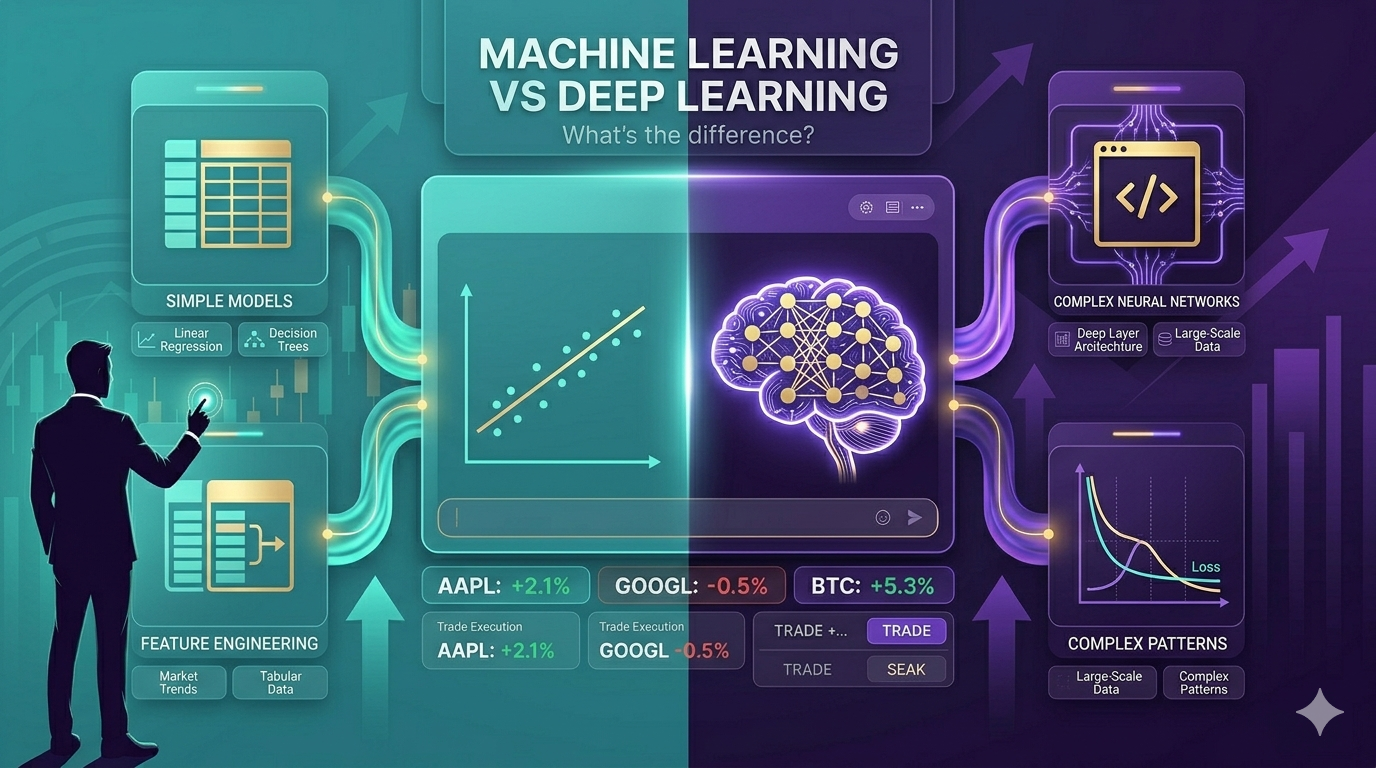
What is Machine Learning?
Machine Learning enables computers to learn from data without explicit programming. It uses algorithms to identify patterns, make predictions, and improve over time.
- Includes supervised, unsupervised, and reinforcement learning
- Commonly applied in recommendation systems, fraud detection, and predictive analytics
- Requires structured datasets for effective learning
What is Deep Learning?
Deep Learning is a specialized subset of ML that uses artificial neural networks to process complex data. It is particularly effective in handling unstructured data like images, audio, and text.
- Uses multiple layers of neural networks for feature extraction
- Key technology behind image recognition, natural language processing, and self-driving cars
- Requires large datasets and significant computational power
Key Differences Between ML and DL
Although both fall under AI, ML and DL differ in approach, complexity, and application. Understanding these differences can help in selecting the right technology for your project.
- ML requires manual feature selection, DL automatically extracts features
- ML works well with smaller datasets; DL needs large datasets
- DL models are more computationally intensive than traditional ML models
💬 Have a Question or Insight?
We’d love to hear your thoughts on Machine Learning and Deep Learning applications. Share your feedback, ideas, or doubts!
👉 Fill out the form on the right side of this article and let us know your insights.